
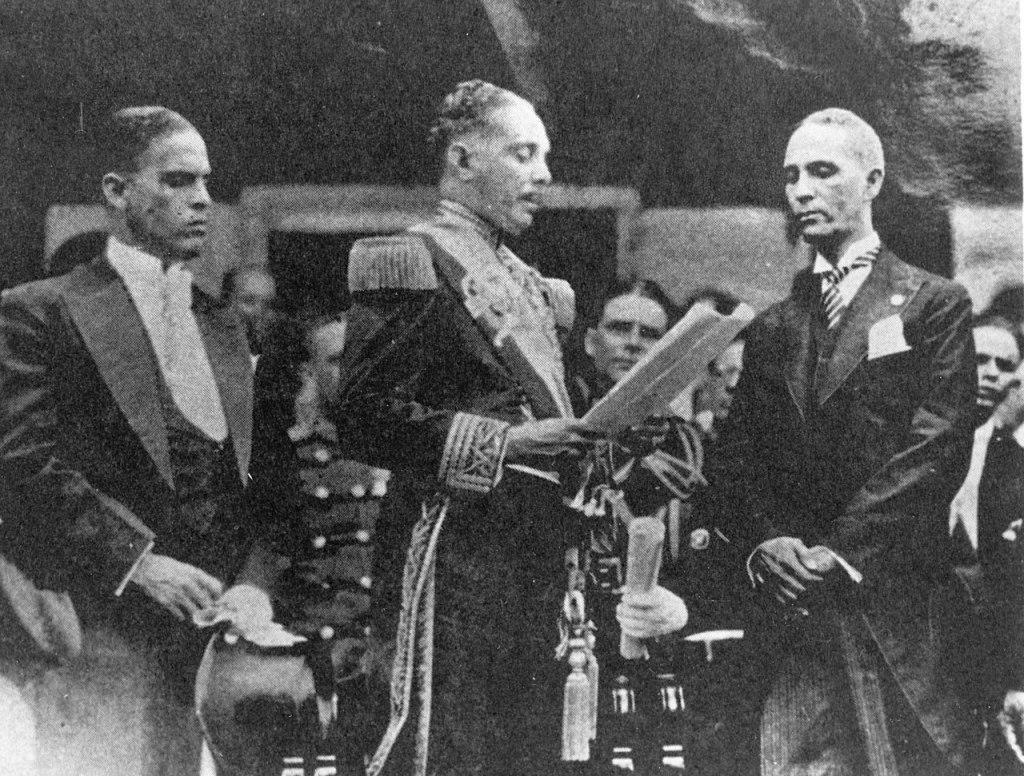
Image source: Archivo General de la Nación, inauguration of Rafael L. Trujillo (16 Aug 1930), public domain (CC0)
On a sultry Caribbean night in May 1961, a small group of conspirators crouched in the darkness beside a coastal highway outside Santo Domingo. They were waiting for one of Latin America’s most feared dictators. A man who had ruled the Dominican Republic with an iron fist for three decades.
At around 10pm on 30 May, Rafael Trujillo’s 1957 Chevrolet Bel Air appeared on the quiet stretch of road. The 69-year-old dictator was travelling with only his chauffeur, heading to visit a mistress.
The ambush was swift and merciless. The conspirators blocked the road and unleashed a hail of bullets. Trujillo tried to fight back but was hopelessly outgunned. Within minutes, one of the hemisphere’s longest-serving tyrants lay dead in the dirt.
The assassins believed they had triggered the collapse of a regime that had terrorised an entire nation. They were catastrophically wrong.
A playboy’s homecoming
By dawn, Ramfis Trujillo was already airborne, racing back from his luxurious exile in Paris. The dictator’s 33-year-old son, a notorious playboy who had spent years living off his father’s blood money in European capitals, landed in Santo Domingo with a single, consuming obsession: revenge.
The secret police, known as the SIM, short for Servicio de Inteligencia Militar, had long been the engine of the dictatorship. Its officers answered to Johnny Abbes García, a stocky, intense man who had built his career by knowing what Trujillo wanted before he said it. Abbes ran a network of informants, safe houses, and interrogation cells that kept the entire country under watch.
The first arrests came within hours. Soldiers raided homes in Santo Domingo, dragging suspects from their beds. Some were shot in the street. Others were taken to the SIM headquarters on Avenida México. Inside, prisoners were beaten, electrocuted, and hung by their wrists until they confessed, true or not.
It wouldn’t take long for Ramfis to come to the interrogations in person. He wore dark glasses and carried a pistol. Witnesses said he walked through the corridors of the prison like a man inspecting property, sometimes watching the sessions in silence. He wanted people to see that the Trujillo name still meant power.
The crackdown went far beyond the gunmen who had ambushed his father. The SIM began targeting anyone remotely connected to them. Wives, cousins, business partners, even distant relatives. Whole families disappeared overnight.
The methods were medieval in their cruelty. Victims were reportedly fed to sharks or burned alive in secret locations across the island. By the end of June 1961, virtually every man connected to the assassination had been executed.
The old order crumbles
But the Trujillo magic built on three decades of fear and patronage was not as strong with Ramfis. The country was broke, isolated by sanctions, and exhausted.
The botched attempt to assassinate Venezuela’s president the year before had turned Latin America against the Dominican Republic. The United States, long content to tolerate the Trujillo’s as an anti-communist ally, had begun to back away.
The 1960 murder of the Mirabal sisters, three female activists who had become symbols of resistance, had particularly shocked Dominican society. The brutal killing of the women, who became known as “Las Mariposas”, had galvanised opposition in ways that decades of male political victims had not.
President Joaquín Balaguer, who had served as Trujillo’s puppet, began quietly distancing himself from the family. More critically, younger military officers – particularly pilots at the San Isidro airbase – started speaking out against the continuing bloodbath.
In November 1961, the dam finally burst. A military rebellion erupted at the airbase, with officers demanding an end to Trujillo rule. As US pressure mounted and the threat of intervention grew, even Ramfis’s reign of terror could not hold the regime together.
The final flight
Facing inevitable collapse, Ramfis made one last, grotesque gesture. He attempted to flee by yacht, bringing his father’s embalmed corpse and dozens of cases packed with cash and jewels looted from the Dominican treasury. The navy blocked his escape.
Eventually, a deal was brokered: the Trujillo family would leave peacefully in exchange for giving up all claims to power. By the end of November 1961, Ramfis had boarded a private jet with his mother, siblings and his father’s body, bound for exile in Spain.
Of the men who had killed Rafael Trujillo on that May night, only two survived the bloodbath that followed: Antonio Imbert Barrera and Luis Amiama Tió.
The Trujillo era was finally over. Ramfis’s six-month campaign of terror had failed to resurrect his father’s regime, but it had come chillingly close to succeeding through pure, methodical savagery.
For the Dominican Republic, it would take years to recover from three decades of dictatorship and the final, blood-soaked months of the dynasty’s death throes.
 Penguin History
Leave a comment